
Program Overview
Students in EET AAS are prepared to perform technical calculations, solve technical problems, use modern computational tools, and identify, formulate, and present creative solutions to technical problems in electrical engineering projects. Graduates of EET AAS work as assistants to electrical engineers in the design, analysis, and laboratory testing of electrical and electronic systems and rotating machinery. In addition, most graduates are employed by electrical and electronic equipment manufacturers, utility companies, the aerospace industry, and manufacturing companies.
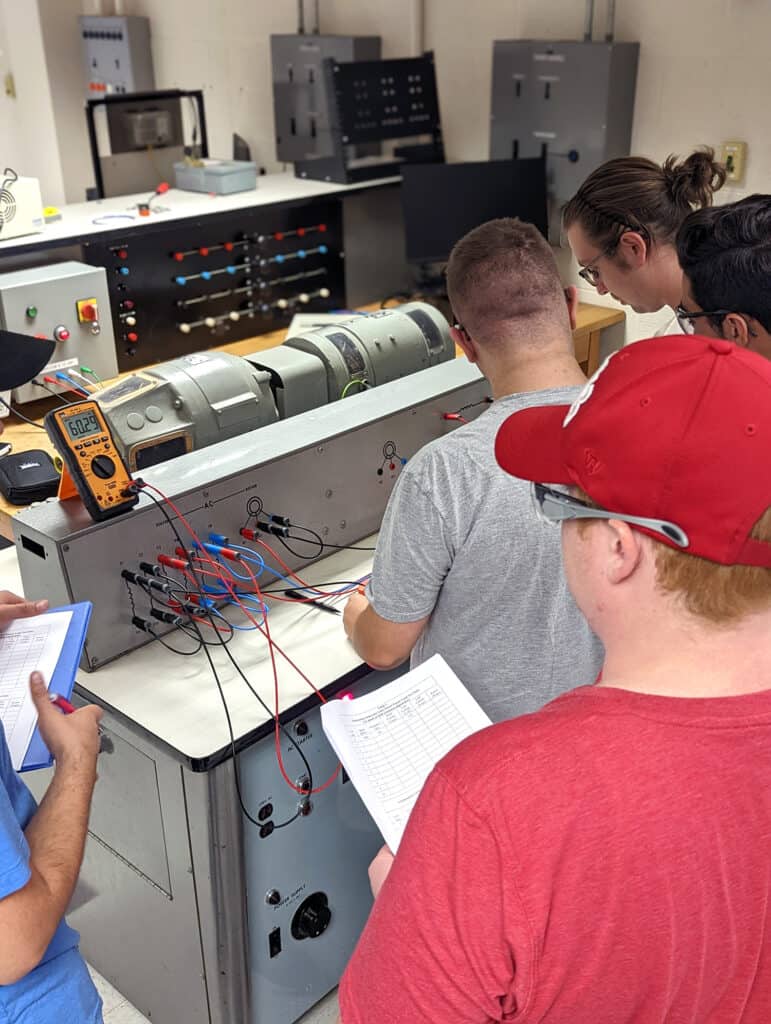
Electrical Engineering Technology (EET) at Youngstown State University blends theory with hands-on experience to prepare students for immediate workforce entry or continuing toward a bachelor’s degree. Students learn how to design, test, and maintain electrical and electronic systems used in manufacturing, energy, automation, and telecommunications industries.
Students gain practical skills through applied coursework and laboratory experience in:
The curriculum emphasizes real-world problem-solving, safety, and teamwork. Graduates are equipped to work with engineers and technologists in designing, building, and maintaining electrical systems across diverse applications.
Graduates of the AAS in Electrical Engineering Technology program find employment in fields such as:
Typical entry-level job titles include:
According to the U.S. Bureau of Labor Statistics (BLS, May 2024 data):
Students who complete the AAS may choose to continue into the Bachelor of Engineering Technology in Electrical Engineering Technology (BETE) program at YSU for advanced study and greater career mobility.
Speak to a Faculty Member
Jason Zapka
Associate Professor, AAS Electrical Engineering Technology
jazapka@ysu.edu
The Associate of Applied Science in Electrical Engineering Technology is accredited by the Engineering Technology Accreditation Commission of ABET, https://www.abet.org, under the General Criteria and the Program Criteria for Electrical Engineering Technology.
The STEM community has a variety of student professional organizations that allow you to grow and foster your learning in an environment with those who share the same interests.
Student professional organizations provide opportunities for you to meet experienced professionals, collaborate with students at other universities, or form relationships with colleagues outside the classroom. They provide social, academic, entrepreneurial, and professional networking opportunities.
Each year, thousands of dollars in scholarships are awarded to students enrolled in the College of Science, Technology, Engineering, and Mathematics. Scholarships come from a variety of sources, vary in amount, and are available to both incoming and current STEM students. Below, you will find further information regarding the opportunities that may be available to you through the STEM College.