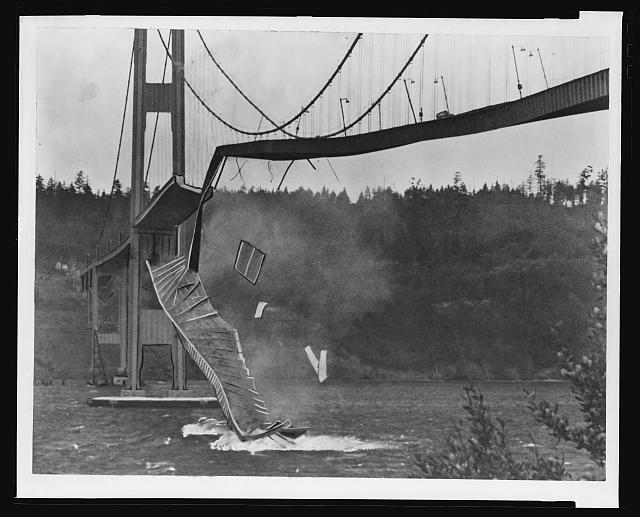
What do collapsing bridges, Georges Seurat, and transorbital lobotomies have in common? All of them have come up in the first-year writing courses I’ve been teaching. When you build a bridge, you must account for how it responds to wind, or else it could fail catastrophically, as the Tacoma Narrows bridge did in November 1940. We talked about this event in a section of Writing 2 (ENGL 1551) specifically designed for Engineering majors.
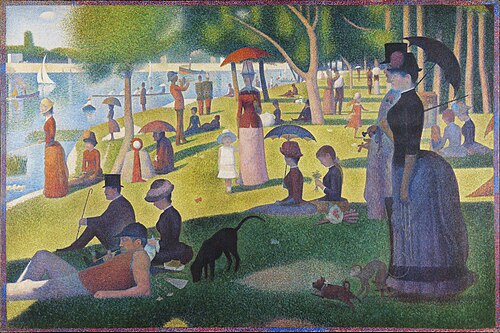
In an art-themed section of the same course, each student picked an artwork and provided a formal descriptive analysis of it, that is, an objective discussion of the relationships among the work’s visual features. One student chose George Seurat’s 1884 painting, A Sunday on La Grande Jatte, and explained how the light and dark areas of the painting worked together to depict both sunlight and pictorial depth.
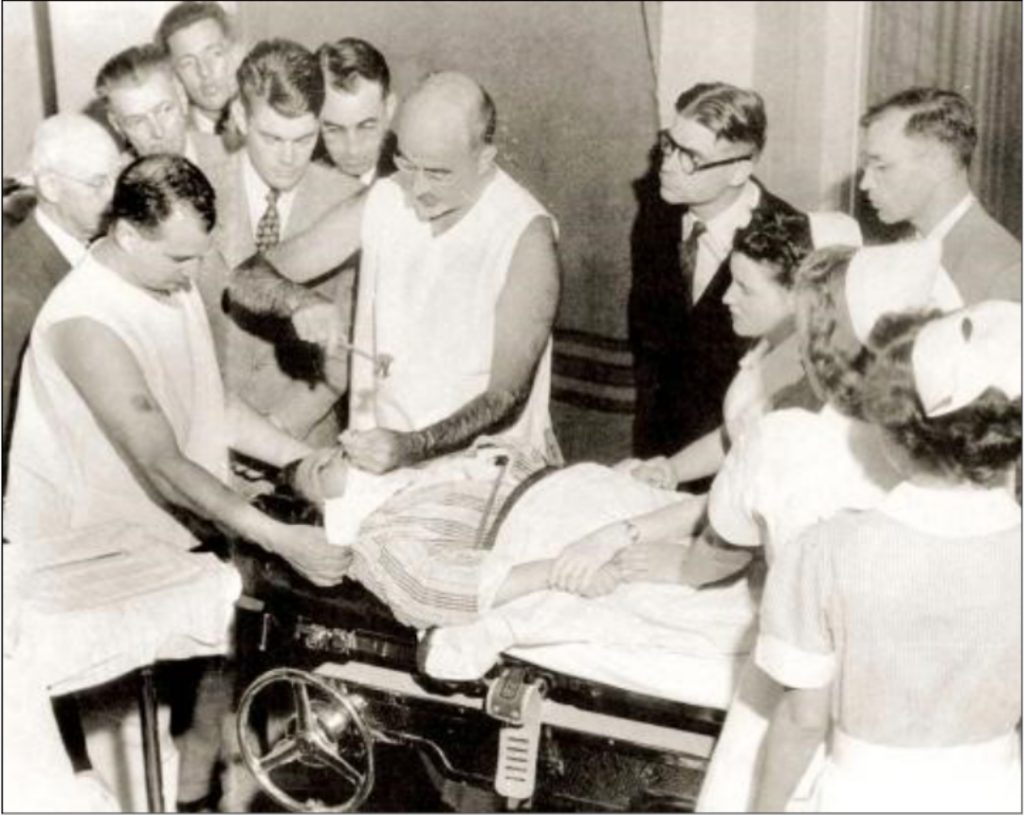
And in a section of Writing 1 (ENGL 1550), students explored and wrote about themes of health and wellness, illness and disease. Central to the course was Howard Dully’s 2008 memoir, My Lobotomy, a book that students found both harrowing and moving as it tells the story of Dully’s transorbital lobotomy at age 12.
All three of these classes have been experiments, but all three are also grounded in the common learning objectives for Writing 1 and Writing 2, as outlined by the Ohio Department of Higher Education (ODHE). While we may explore a wide range of topics across the three sections, we always return to those basic objectives: forming good questions for inquiry, doing competent research, writing with attention to purpose and audience, and learning about genres of academic and professional writing. Below I explain in a bit more detail how each class came to be.
Since fall 2024, I’ve been teaching a version of Writing 2 for YSU’s engineering majors. The course is set up like every other section of Writing 2—it must be. The ODHE requires all Writing 2 courses at Ohio’s state universities to work toward the same basic learning objectives. However, in this class, we talk about not only rhetoric and research (two elements of every Writing 2 class), but also engineering concepts, such as problem solving, the role of technology in our lives, and what it means to think like an engineer.
How did I get this gig? After all, I am not an engineer myself. First, I do have a longstanding personal interest in the ways in which culture, technology, and an engineering outlook intersect one another. One of my students this semester, for example, wrote about hostile architecture. Hostile architecture includes techniques in the design of public spaces to manage human behavior. As with so many engineering problems, sometimes solving one problem (keeping people from sleeping overnight on park benches) leads to another (where are those people going to sleep, then?). This is the kind of issue we discuss in the course.
Second, I consulted with the YSU’s Engineering faculty throughout spring 2024, so I could assess their sense of the writing needs of their majors. Engineering faculty helpfully articulated their concerns both broad and narrow. They want their students to write with an engineering mindset. They also want to see engineering values—precision, objectivity, attention to detail—reflected their students’ writing. In addition, they want to see their majors become familiar with the building blocks of engineering writing—descriptions, explanations, and research-based proposals. From these meetings, I developed a plan for what to address in the course and produced a syllabus. I am now teaching the third iteration of this version of Writing 2.
To develop a section of Writing 2 for Art majors, which I am currently teaching, I first participated in a half-semester seminar on “writing in the disciplines.” During the seminar, I worked closely with faculty from the Art department. My role again was to learn what I could about the writing expectations faculty have of their majors. For example, they want students to write objectively and analytically about art.
But to teach this skill, first I had to understand what it meant. I had always believed that writing about art mean writing art reviews and art criticism, both of which were subjective and evaluative. In conversations with the Art faculty, their outlook became clear. They want their students to work on noticing what is happening in works of art visually. And to develop their capacity to notice, students are best served by writing tasks that help them record what they see.
To understand this outlook, I remembered something from my own painting courses. We were told, “paint what you see, not what you know.” A human nose is not a triangle, visually: it is an ever-changing collage of lights and darks, pinks and browns and yellows and blues. Paint what you see; write what you see. It made sense, and after this realization, it became much easier to develop assignments for the class.
In November 2024, I presented an idea for a “health humanities” version of Writing 1 at the annual MMLA meeting. What is “health humanities”? As one organization defines it, “Health/Medical Humanities is a broad, transdisciplinary field that unites practicing health professionals, traditional humanities scholars, artists, writers, and humanities and social science students, as well as pre-health and health professions students.”
In consultation with colleagues Diana Awad Scrocco and Laura Beadling, I developed a presentation that outlined what I imagined a health-humanities-themed version of Writing 1 might look like. Intending to run the course for the following fall, I solicited feedback from the audience. From there, I put together a syllabus, devised assignments (mindful of the ODHE learning outcomes for Writing 1), and selected a text.
The vision became a reality in fall 2024. I kicked off the course with an assignment called a pathography, that is, a narrative account of somebody’s health condition or experience with the healthcare industry. Students were free to write about themselves (in which case it was an autopathography) or others, as long as they and the others were comfortable with the idea.
As a model autopathography, I used Howard Dully’s memoir, My Lobotomy, as the central text. My Lobotomy was a mixed blessing. From my perspective, it touched on many key themes that we addressed throughout the course: diagnosis and treatment, mental and physical health, the relationship between healthcare professional and the layperson, and the role of historical context in our understanding of the ethics of a particular medical treatment.
At the same time, the procedure itself is shocking to consider and even more repellant to watch—even the aftermath of a transorbital lobotomy is disturbing to see, as the patient emerges often with black eyes and a somewhat distorted appearance, at least until the wounds heal. Moreover, I was keenly aware that some of the students simply didn’t to talk about lobotomies at eight in the morning. Nevertheless, the students were troopers throughout the 16 weeks and did a lot of good writing.
A caveat for those considering themed first-year writing courses
As the point above about the Dully book makes clear, how the theme is reflected in course materials and requirements must be considered. One must ask oneself, what are first-year students likely to find engaging and stimulating to discuss and writing about? Health and wellness, illness and disease? Sure. Lobotomies in particular? Maybe not.
More generally, one potential pitfall in the themed first-year writing course is the very fact of having a theme: What if students would rather write about a variety of themes? What if they don’t want to deal with one field’s issues all semester? And, if they are majors in the field that the theme represents, what if they begin to feel over-saturated—what if art majors, for example, don’t want to take yet another course focused on nothing but art? These are valid questions.
One solution here may be to spend some time developing a course and assignments that offer students alternatives without losing sight of the central course theme. For example, since noticing is a key skill for art majors to develop, a visual analysis assignment could permit students to move beyond the art world to other realms in which close attention to visual detail is valued: observing human activity in a library or coffee shop, focusing closely on a device or machine to understand its parts and their interrelationships, and so on. Ultimately, I believe that themed versions of both Writing 1 and Writing 2 can be very engaging and educational if thought through well and modified as needed.
— Jay Gordon, Associate Professor of English, Youngstown State University