Recently, in my Graphic Novels class (ENGL 3715), I taught Nimona, a young adult (YA) graphic novel about a young shapeshifter who joins supervillain Ballister Blackheart as his sidekick against Sir Goldenloin and the Institute.
When I teach literature classes, I sometimes include a YA book for a few reasons. I often have future teachers in my English classrooms, and it can be useful for those folks to have solid options for things to teach in their own classrooms that they’ve had a chance to read, analyze, and discuss in an academic setting. Also, most of my students will go on to be parents (or already are parents) or have younger relatives, and so they might also find a YA book useful. Finally, the YA market in recent years has extended well beyond the 12-18 crowd and some research shows that as much as 70% of YA literature is actually purchased by people older than 18. Understanding our current literary moment must include the juggernaut of YA literature, much of which has wide crossover appeal. Not only are adults buying these books, research also shows that they are reading them.
My students really enjoy watching the creator, ND Steveson, deconstruct the superhero genre (which they are, to a person, very knowledgeable about) as the narrative progresses. On the first page, Nimona identifies herself as the willing sidekick to Blackheart, the supervillain, against the hero, Goldenloin and his backer, the Institute. However, before long, students see that Blackheart is more depressed and disillusioned than evil, while Goldenloin is no hero as the Institute commands him to do more and more evil things, which he (mostly) acquiesces to. Nimona herself is just all sorts of chaotic fun (in a running gag, she frequently turns herself into a shark!) as she always prefers the more extreme option in the face of Blackheart’s pragmatism and moral concerns.
Another aspect of the book that my students enjoy discussing is the hybrid genre of sci-fi fantasy. While most works confine themselves to one or the other, Nimona gleefully features dragons, castles, and jousting knights alongside scientists, surveillance technology, and television. We discuss how these usually-discrete genres combine in unexpected ways that enliven the reading experience. We also look at the readership for each genre and discuss what each might find in Nimona that is familiar and unfamiliar to them. Lastly, we discuss how appropriate this hybrid genre is to a story that is all about blurring usually-separate categories, crossing boundaries, and growing beyond your comfort zone.
The book is wildly enjoyable but also has a lot to discuss in terms of both content and form. Stevenson’s work is good to teach in part because he sets up a pretty regular page layout of usually three tiers with two panels each. They are almost always rectangular in shape and clearly bordered. However, he does vary it up and it is always worth discussing it when he does. For instance, this time around, we spent a lot of time analyzing this page:
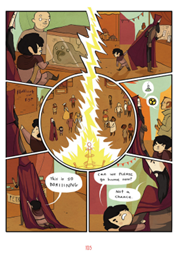
This page’s layout is unique in the book and Stevenson teaches you as you read his work to pay attention to when he varies his otherwise regular layout choices. At this moment in the story, Nimona has shapeshifted into a little boy who is taken to be a disguised Blackheart’s son. The students found the irregular shaped panels with the circular image in the center indicative of the importance of this moment to Nimona and Blackheart’s relationship. Because of her awesome powers, Nimona has never been able to be a child and this page shows the development of a parent/child relationship between the two that will play out as the narrative continues.
Although Nimona was recently adapted as a Netflix film, I haven’t yet had a chance to watch it. My students who have seen it tell me that it’s good but it’s very, very different from the graphic novel. Those of you have seen the film, is it worth watching? If you’ve seen both, which do you prefer? I’m always curious about how people react to adaptations depending on which version(s) they’ve seen!
— Laura Beadling, Professor of English, Youngstown State University